










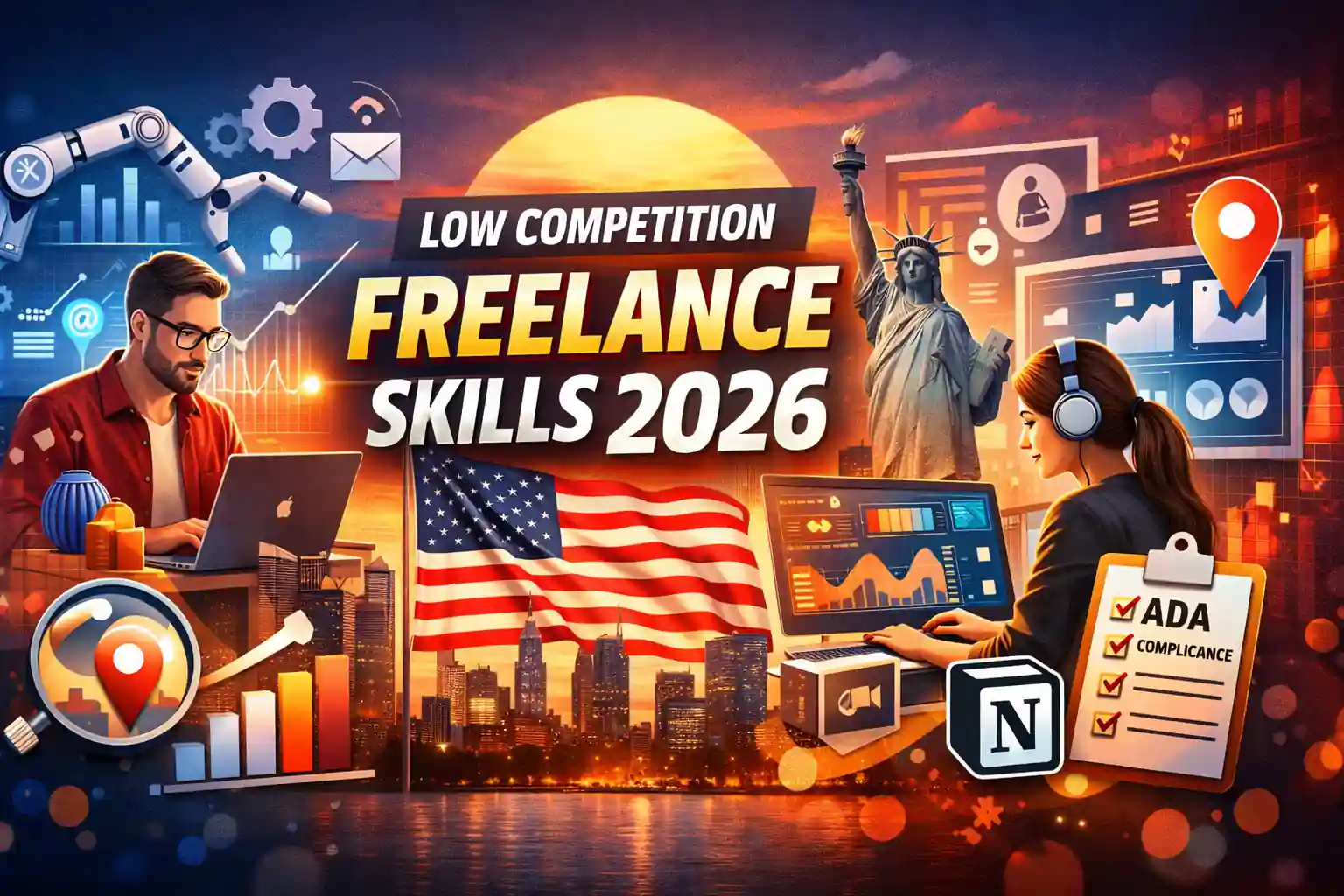

The freelance economy in the United States is evolving faster than ever. While many traditional freelance skills like general graphic design or blog writing are now saturated, 2026 is shaping up to reward specialists who operate in low-competition, high-value niches. Businesses across the U.S. are increasingly seeking experts who solve specific, technical, or strategic problems rather than offering generic services. That shift creates massive opportunity for freelancers willing to position themselves strategically. In this guide, we will explore the most promising low competition freelance skills for 2026 that offer strong income potential, long-term stability, and authority positioning. If you’re aiming to build a premium freelance brand rather than compete in crowded marketplaces, this article is built for you.
Table of Contents
- 1.Why High-Value Niche Skills Dominate in 2026
- 2.AI Workflow Automation Specialist
- 3.Local SEO Authority Consultant (USA Market)
- 4.Conversion Rate Optimization (CRO) Specialist
- 5.Accessibility & Compliance Consultant
- 6.Email Newsletter Monetization Strategist
- 7.Notion / System Architecture Expert
- 8.Data Visualization & Insight Reporting
- 9.Why Specialization Reduces Competition
- 10.How to Position Yourself as a Premium Freelancer
- 11.Real-World Income Potential in the USA
- 12.Conclusion
- 13.Frequently Asked Questions
Why High-Value Niche Skills Dominate in 2026
In 2026, U.S. businesses are no longer looking for “general freelancers.” They are hiring specialists who understand industry pain points and can deliver measurable ROI. The rise of AI tools has automated many entry-level freelance tasks, increasing competition in low-barrier services. However, complex implementation, optimization, and strategic planning still require human expertise. This is where niche freelancers thrive. When you focus on a specific problem—like conversion optimization for SaaS startups or accessibility audits for eCommerce—you reduce competition dramatically. Instead of competing with thousands globally, you compete with a small pool of experts. That scarcity allows you to charge premium rates while building authority in a defined vertical.
AI Workflow Automation Specialist
As businesses integrate AI tools into operations, they often struggle with implementation and workflow design. Becoming an AI Workflow Automation Specialist is one of the most powerful low competition freelance skills in 2026. Companies in the U.S. need professionals who can connect tools like CRM systems, AI writing tools, marketing automation, and data dashboards into efficient systems. This is not about basic prompting; it’s about building scalable automation frameworks. For example, a small marketing agency may pay $3,000–$8,000 for a fully integrated workflow that saves dozens of labor hours monthly. Because the skill requires both technical and strategic knowledge, competition remains limited. This niche rewards freelancers who understand both business operations and automation logic.
Local SEO Authority Consultant (USA Market)
While general SEO is highly competitive, hyper-focused Local SEO consulting remains relatively low competition, especially when targeting specific U.S. industries such as dentists, HVAC services, or personal injury law firms. Local businesses depend heavily on Google Maps visibility, reviews, and geo-targeted optimization. A Local SEO Authority Consultant who understands U.S. search behavior, regional competition, and compliance standards can charge premium retainers. Instead of writing random content, this role focuses on ranking Google Business Profiles, optimizing citations, and creating local authority signals. Many freelancers overlook this niche, but demand continues growing as small businesses compete for neighborhood visibility. Specialization within specific states or industries further reduces competition and increases pricing power.
Conversion Rate Optimization (CRO) Specialist
Traffic without conversions is wasted money. U.S. eCommerce brands and SaaS startups are investing heavily in Conversion Rate Optimization (CRO) experts who analyze data and improve user journeys. Unlike general marketing freelancers, CRO specialists focus on analytics, A/B testing, behavioral psychology, and funnel optimization. This skill remains relatively low competition because it requires both technical and analytical expertise. For example, improving conversion rates by just 1% can increase annual revenue significantly for mid-sized companies. That direct ROI impact justifies high freelance retainers. Instead of competing for low-budget projects, CRO specialists position themselves as revenue growth partners. This strategic positioning reduces competition and attracts premium U.S. clients.
Accessibility & Compliance Consultant
With increasing digital compliance laws in the United States, website accessibility and ADA compliance have become essential for businesses. Many companies face lawsuits due to inaccessible websites. This creates demand for Accessibility & Compliance Consultants who can audit and optimize websites for legal standards. Few freelancers specialize in this area, making it a strong low competition skill for 2026. This role involves reviewing website structure, navigation, alt text, color contrast, and usability for assistive technologies. Businesses are willing to pay high fees to avoid legal risks. Because it combines technical auditing with regulatory understanding, competition remains lower compared to traditional web design services.
Email Newsletter Monetization Strategist
Email marketing is not new, but strategic newsletter monetization is becoming increasingly valuable in the U.S. market. Businesses, creators, and media brands want to turn newsletters into revenue machines. An Email Newsletter Monetization Strategist helps optimize subscriber funnels, increase open rates, design storytelling sequences, and integrate sponsorship models. This niche is less crowded than generic email marketing because it requires revenue strategy knowledge. For example, a well-optimized newsletter can generate recurring sponsorship income or product sales. Freelancers who master segmentation, deliverability, and monetization psychology can command premium retainers. In 2026, owned audiences are more valuable than social media followers, increasing demand for this specialized skill.
Notion & Business System Architect
Companies increasingly rely on tools like Notion for internal knowledge management and workflow organization. A Notion & Business System Architect designs structured dashboards, automation processes, and collaborative systems tailored to U.S. startups and agencies. While many freelancers claim to “know Notion,” few offer structured system architecture expertise. That gap creates opportunity. Businesses are willing to invest in customized systems that increase team productivity. This niche is low competition because it blends technical setup with business logic. Instead of competing in general virtual assistant roles, system architects position themselves as operational consultants, which significantly increases pricing authority and long-term client retention.
Data Visualization & Insight Reporting Specialist
Raw data is everywhere, but actionable insights are rare. Companies want clear dashboards and visual storytelling that help executives make decisions. Data Visualization & Insight Reporting Specialists transform analytics into executive-level reports using tools like Power BI or advanced spreadsheets. This is not basic data entry; it’s strategic analysis and presentation. Many freelancers avoid this niche due to its technical depth, which reduces competition. U.S. companies value professionals who simplify complexity. When freelancers provide recurring reporting services tied to KPIs, they create stable monthly income streams. This skill is especially powerful in SaaS, finance, healthcare, and eCommerce sectors.
Why Specialization Reduces Competition
Freelancing becomes competitive only when positioning is vague. When someone markets themselves as a “freelance marketer,” they compete globally. However, when positioned as a “Conversion Optimization Specialist for U.S. SaaS Startups,” competition narrows significantly. Specialization signals authority and justifies higher pricing. It also aligns with how U.S. businesses search for experts online. Instead of bidding on crowded platforms, niche freelancers attract inbound leads through content authority and strategic networking. The deeper your expertise, the fewer competitors you face. In 2026, clarity of positioning is more powerful than skill variety.
How to Position Yourself as a Premium Freelancer
To succeed in high-value niches, positioning matters more than platforms. First, build authority content around your niche topic. Publish case studies demonstrating measurable ROI. Second, optimize your website for U.S. audiences with clear service pages and industry targeting. Third, avoid generic gig marketplaces as your primary channel; instead, focus on LinkedIn networking and direct outreach. Finally, package your services into premium retainers rather than hourly tasks. Clients perceive strategic consulting differently from task-based freelancing. In 2026, perception drives pricing power.
Real-World Income Potential in the USA
High-value niche freelancers in the U.S. commonly charge between $75 and $200 per hour depending on expertise. Automation specialists, CRO experts, and compliance consultants often secure $3,000–$10,000 project contracts. Unlike saturated skills that require volume to earn, niche freelancers need fewer clients to reach six-figure annual income. For example, landing five retainer clients at $2,000 per month creates $120,000 yearly revenue. This income model reduces workload while increasing strategic value. Specialization is not just about less competition—it is about building sustainable income with authority positioning.
Conclusion
The future of freelancing in 2026 belongs to specialists. Instead of entering saturated markets, focus on high-value, low competition freelance skills that solve complex business problems. Whether it’s AI workflow automation, CRO optimization, compliance consulting, or system architecture, the key is depth over breadth. U.S. businesses are willing to pay premium rates for measurable impact. By positioning yourself strategically and building authority within a defined niche, you dramatically reduce competition while increasing earning potential. Freelancing success in 2026 is not about doing more tasks—it’s about solving bigger problems.
Frequently Asked Questions
1. Are low competition freelance skills really profitable?
Yes. Lower competition usually indicates specialization. When skills require technical expertise or strategic knowledge, fewer freelancers qualify, which increases pricing potential.
2. How do I know if a skill is saturated?
If thousands of freelancers offer identical services without differentiation, the market is saturated. Niche positioning reduces that issue significantly.
3. Do I need advanced education for these skills?
Not necessarily. Many high-value skills can be self-taught through structured learning and real-world practice.
4. How long does it take to build authority?
With focused positioning and strategic content marketing, many freelancers build niche authority within 6–12 months.