








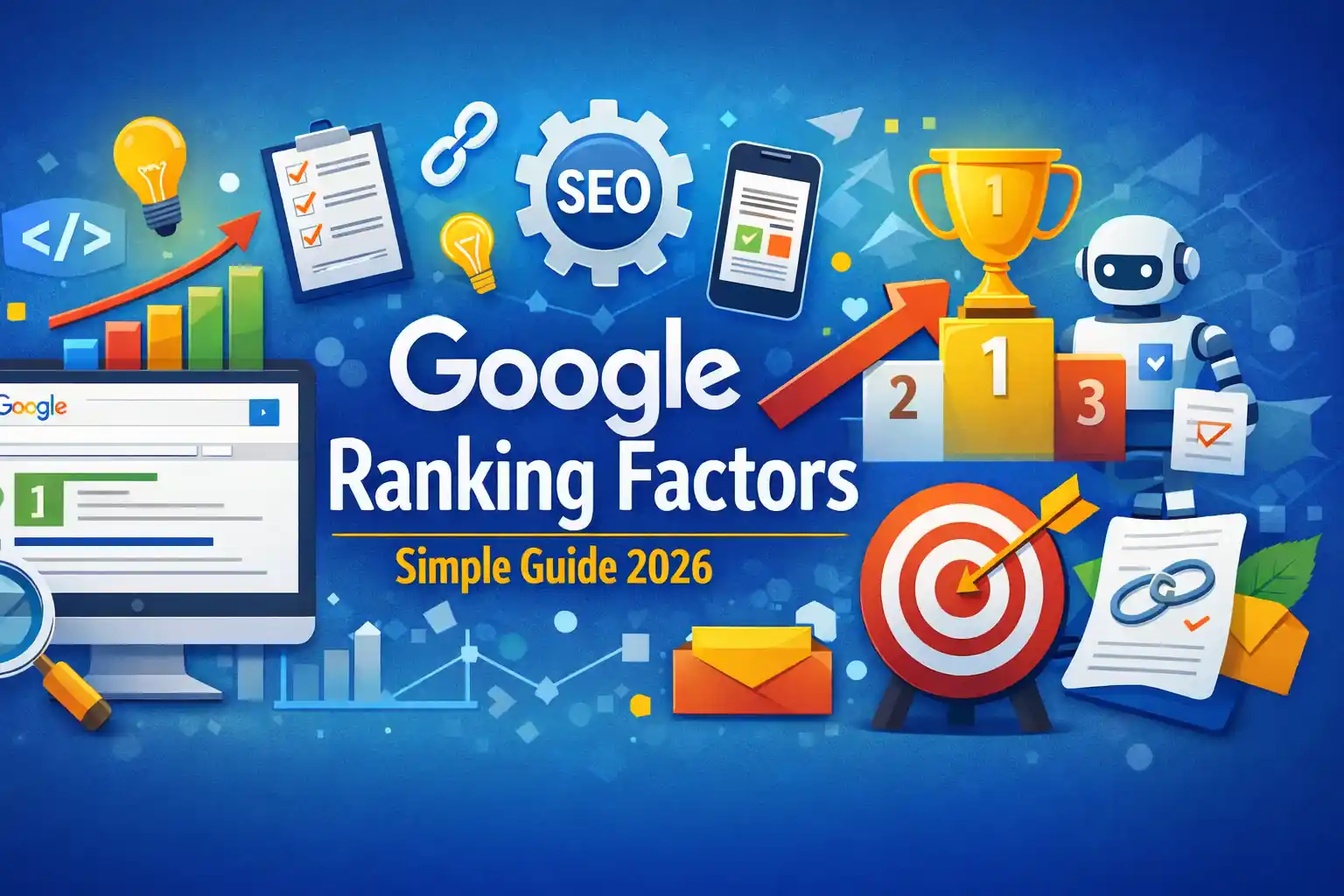

If you want to rank on Google in 2026, you don’t need 200 complex strategies.
You need clarity.
Google’s algorithm has evolved, but its mission remains the same:
Deliver the most helpful, trustworthy, and relevant content to users.
In this simple guide, I’ll break down:
- 1.What Google ranking factors really mean
- 2.Which ones matter most in 2026
- 3.What beginners should focus on
- 4.A step-by-step ranking roadmap
Whether you’re building a blog, niche site, or business website targeting the USA audience, this guide will help you build rankings the right way.
📑 Table of Contents
- 1.What Are Google Ranking Factors?
- 2.How Google’s Algorithm Works in 2026
- 3.The 5 Most Important Ranking Factors Today
- 4.On-Page SEO Simplified
- 5.Technical SEO Essentials
- 6.Off-Page SEO & Authority Building
- 7.Real Example: Ranking a Beginner Blog
- 8.Common SEO Mistakes in 2026
- 9.FAQ Section
- 10.Final Thoughts
What Are Google Ranking Factors?
Google ranking factors are signals Google uses to decide:
- 1.Which pages show up
- 2.In what order
- 3.Who deserves page one
Google evaluates:
- 1.Relevance
- 2.Quality
- 3.Authority
- 4.User experience
Instead of chasing every minor factor, focus on the core principles that consistently drive results.
How Google’s Algorithm Works in 2026
Google’s algorithm now heavily emphasizes:
- 1.User intent
- 2.Content depth
- 3.Experience-based expertise (E-E-A-T)
- 4.Page performance
- 5.Trust signals
In 2026, SEO is no longer about tricks.
It’s about alignment.
If your content truly satisfies the user, rankings follow.
The 5 Most Important Ranking Factors in 2026
Let’s simplify everything into five pillars.
1️ Search Intent Matching
This is the foundation.
Before writing any content, ask:
What is the user really looking for?
For example: If someone searches “Google ranking factors simple guide 2026,”
they want:
- 1.Updated information
- 2.Beginner-friendly explanation
- 3.Actionable tips
Not academic theory.
Matching intent increases:
- 1.Time on page
- 2.Engagement
- 3.Conversion
- 4.Rankings
2️ High-Quality, Helpful Content
Google now prioritizes:
- 1.Original insights
- 2.Clear structure
- 3.Real examples
- 4.Updated information
Thin content does not rank in competitive USA markets.
Best practice for 2026:
- 1.1500–2000 words when necessary
- 2.Proper headings (H2, H3)
- 3.Bullet points for readability
- 4.Clear explanations
3️ User Experience & Core Web Signals
Google tracks how users interact with your page.
Important metrics:
- 1.Page speed
- 2.Mobile friendliness
- 3.Visual stability
- 4.Engagement rate
If your site loads slowly, users leave.
And Google notices.
In the USA, users expect fast and seamless browsing.
4️ Authority & Backlinks
Backlinks remain powerful in 2026.
But quality matters more than ever.
One relevant backlink from a trusted site can outperform dozens of low-quality links.
Beginner strategy:
- 1.Create link-worthy content
- 2.Guest post strategically
- 3.Build niche authority
5️ E-E-A-T (Experience, Expertise, Authority, Trust)
Especially important for:
- 1.Finance
- 2.Health
- 3.Business
- 4.AI
- 5.Marketing
Google wants to see:
- 1.Real experience
- 2.Clear expertise
- 3.Trustworthy tone
- 4.Transparent authorship
Add:
- 1.Author bio
- 2.Real examples
- 3.Updated statistics
- 4.Clear references when needed
This builds long-term credibility.
On-Page SEO Simplified
On-page SEO means optimizing elements inside your page.
Key components:
Title Tag
Must include main keyword naturally.
Meta Description
Encourage clicks, not just rankings.
Headings
Use structured H2 and H3 tags.
Keyword Placement
Natural, not forced.
Internal Linking
Link related articles to build topical authority.
Technical SEO Essentials
Technical SEO ensures Google can properly crawl and index your site.
Focus on:
- 1.Fast hosting
- 2.Clean site structure
- 3.Secure HTTPS
- 4.Mobile responsiveness
- 5.XML sitemap
- 6.Fix broken links
You don’t need advanced coding skills.
Just ensure your site is technically clean.
Off-Page SEO & Authority Building
Off-page SEO is about reputation.
Google asks:
Do other sites trust you?
How to build authority:
- 1.Publish research-style content
- 2.Offer unique insights
- 3.Share data
- 4.Build brand presence
Authority compounds over time.
Real Example: Ranking a Beginner Blog in 2026
Let’s say you launch a digital marketing blog targeting USA small businesses.
Instead of targeting: “SEO tips”
You target: “SEO tips for small business owners in Texas”
This is:
- 1.Specific
- 2.Location-based
- 3.Lower competition
- 4.High intent
You then:
- 1.Write 1800 words
- 2.Add real examples
- 3.Include local context
- 4.Optimize headings
- 5.Improve speed
- 6.Get 2–3 local backlinks
Within months, rankings become realistic.
That’s smart SEO.
Common SEO Mistakes in 2026
Avoid these:
❌ Writing for search engines, not users
❌ Publishing short, generic articles
❌ Ignoring mobile optimization
❌ Buying spam backlinks
❌ Targeting highly competitive keywords too early
SEO is strategic patience.
Step-by-Step Ranking Blueprint
If you’re just starting, follow this:
Step 1: Choose Long-Tail Keywords
Target low competition phrases.
Step 2: Create Deep, Helpful Content
Answer the question fully.
Step 3: Optimize Structure
Use proper headings and formatting.
Step 4: Improve Speed & Mobile Experience
Technical basics first.
Step 5: Build Authority Gradually
Quality over quantity.
Consistency beats shortcuts.
FAQ: Google Ranking Factors 2026
How many ranking factors does Google use?
Google uses hundreds of signals, but beginners should focus on core principles like content quality, user intent, speed, and authority.
Are backlinks still important?
Yes. High-quality backlinks remain one of the strongest ranking signals.
How long does it take to rank?
For low competition keywords: 3–6 months.
For competitive niches: 6–12 months or more.
What is the #1 ranking factor?
Search intent alignment combined with high-quality content.
Can beginners rank without backlinks?
Yes, for very low competition long-tail keywords.
But long-term growth requires authority building.
Final Thoughts
SEO in 2026 is simpler than it seems.
You don’t need hacks.
You need:
- 1.Helpful content
- 2.Technical cleanliness
- 3.Authority signals
- 4.User satisfaction
If you focus on delivering real value — especially to a USA audience — Google rewards consistency.
Ranking isn’t magic.
It’s strategic execution.