








If you live in a small town in the U.S., you’ve probably heard this at least once:
“You’d do so much better if you lived in a big city.”
I used to believe that too.
But after working online for several years—and watching friends quietly build solid online incomes from places most people can’t even find on a map—I’ve learned something important: small towns are not a disadvantage anymore. In many cases, they’re an edge.
Lower living costs. Fewer distractions. And honestly? More time to actually focus.
The mistake most solo founders make is copying business ideas that are already crowded—dropshipping stores, generic blogs, or “get rich quick” models that worked five years ago. Those spaces are noisy, competitive, and exhausting.
What does work—especially for solo founders in small U.S. towns—are low-competition online businesses that solve boring but real problems.
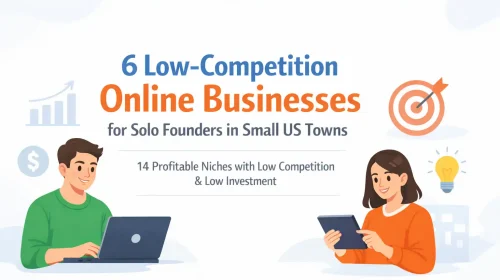
Below are 6 online business models I’ve seen work repeatedly. No hype. No overnight millionaire stories. Just realistic paths you can build from anywhere.
Table of Contents
- Local SEO & Google Business Profile Management
- Niche Content Websites (Small but Profitable)
- Virtual Bookkeeping for Small Businesses
- AI-Assisted Freelance Writing for Local Niches
- Practical Online Courses for Everyday Skills
- Hyper-Local Print-on-Demand Brands
- Real Experience: Why Small-Town Founders Win
- Realistic Examples
- Conclusion
- FAQ
1. Local SEO & Google Business Profile Management
This is one of the most underrated online businesses in the U.S.—especially outside major cities.
Here’s the truth:
Most local businesses in small towns don’t understand Google. They just want the phone to ring.
Plumbers, roofers, dentists, cleaning companies—many of them still have half-filled Google Business Profiles with wrong hours and zero strategy.
Why this is low competition
- Few people offer this service locally
- Business owners don’t want agencies—they want a person
- Results are visible (calls, maps ranking)
Real talk
I’ve seen solo founders charge $300–$600/month per client for basic optimization and review management. You don’t need 50 clients. Even 10 is life-changing in a small town.
Click here for more details about online business
2. Niche Content Websites (Not Generic Blogs)
Most blogs fail because they’re too broad.
Instead of “make money online,” think:
- “Moving to rural Texas after retirement”
- “Cold-weather home maintenance for Midwest homeowners”
- “RV living tips for couples over 50”
These topics don’t look sexy—but they rank.
Why this works
- Less competition
- Clear audience
- Google Discover loves lifestyle + practical content
Monetization usually comes from ads, affiliates, and later digital products. It’s slow at first, but stable long-term.
3. Virtual Bookkeeping for Small US Businesses
This one surprises people—but demand is huge.
Small businesses hate paperwork. Many are still using spreadsheets or shoebox accounting. They don’t need big firms. They need someone reliable.
Why it’s perfect for solo founders
- Remote
- Predictable monthly income
- Trust builds fast
You don’t need to be a CPA to start. Many successful bookkeepers learned on the job using tools like QuickBooks and Wave.
4. AI-Assisted Freelance Writing (Local Focus)
Freelance writing is crowded—unless you niche down.
Click to learn more about digital marketing
Instead of writing for everyone, write for:
- HVAC companies
- Local law firms
- Real estate agents
- Medical clinics
AI helps with speed, but clients pay for clarity, accuracy, and trust—not raw text.
Reality check
Local businesses don’t care if you use AI. They care if customers understand their service and call them.
5. Practical Online Courses (Not Influencer Stuff)
People don’t just buy “dream” courses. They buy problem-solving courses.
Examples that actually sell:
- “How to start a small-town cleaning business”
- “Basic tech skills for seniors”
- “Simple bookkeeping for side hustlers”
Small audience. High trust. Less competition.
Click to learn more about earning online
6. Hyper-Local Print-on-Demand Brands
Forget generic t-shirts.
Local pride sells. Always has.
Think:
- Town slogans
- State humor
- Local sports pride
Print-on-demand works because:
- No inventory
- Emotional connection
- Low upfront cost
Small audiences convert better than massive generic ones.
Real Experience: Why Small-Town Founders Quietly Win
Here’s something I’ve noticed again and again:
Small-town founders don’t talk much—but they execute.
Lower rent means less panic. Less noise means more consistency. Many build slow, boring businesses that quietly hit $3k–$10k/month without burnout.
They don’t chase trends. They stick with systems.
Realistic Examples
- A solo founder in rural Ohio managing Google Business Profiles for 12 clients
- A niche blog run from Idaho earning steady ad income
- A virtual bookkeeper serving clients across three states
None of them went viral. All of them stayed consistent.
Conclusion
You don’t need a big city, a big audience, or a big budget.
If you live in a small U.S. town, your advantage is focus. Pick a low-competition business. Serve real people. Solve boring problems.
Online success isn’t about location anymore.
It’s about choosing the right lane and staying in it.
Frequently Asked Questions (FAQ)
Is this beginner-friendly?
Yes. Most of these businesses can be learned step-by-step.
How much money do I need to start?
Many start with under $200.
How long before income?
Service businesses: weeks.
Content sites: months—but scalable.
Can this be part-time?
Absolutely. Most solo founders start evenings or weekends.