








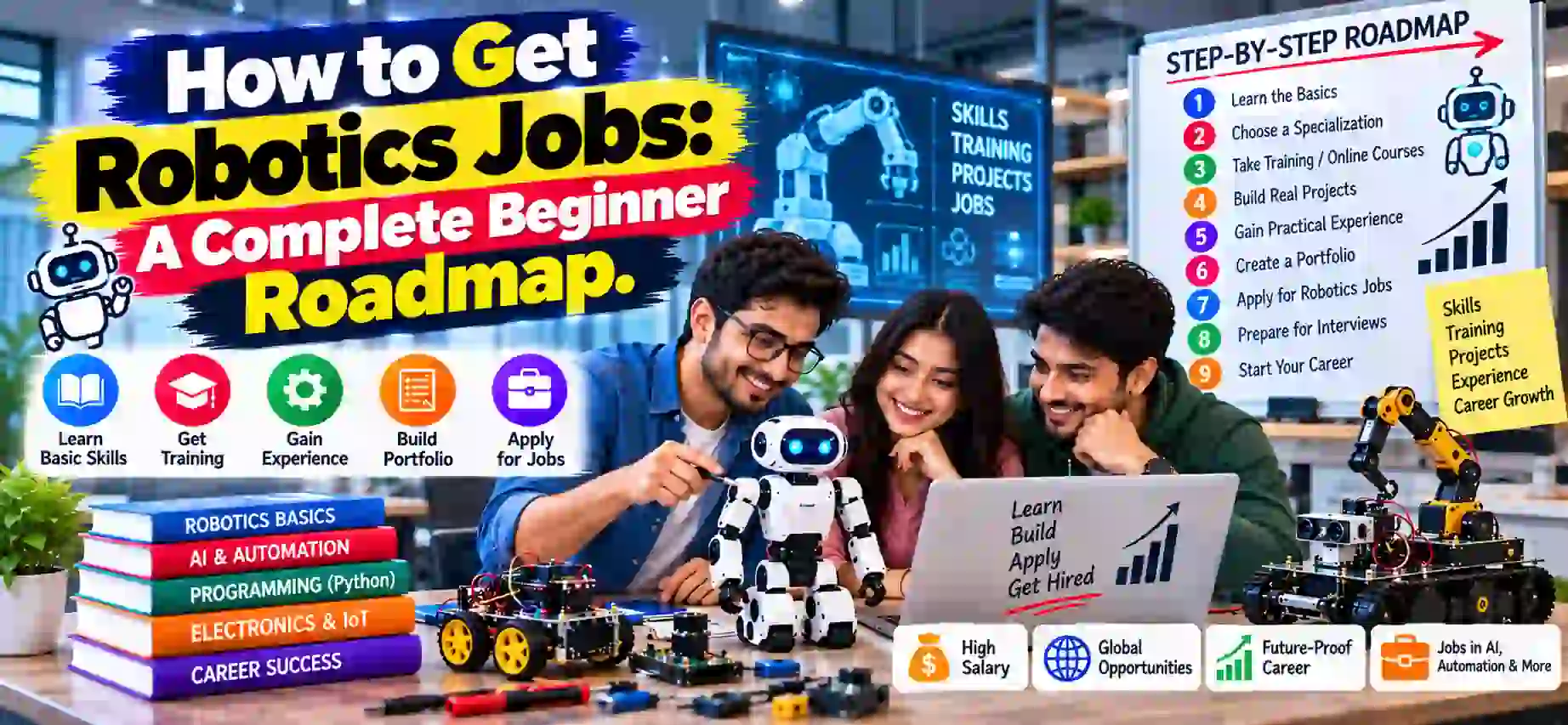

An actionable, step-by-step guide designed to take absolute beginners from zero experience to a job-ready portfolio in the booming fields of automation and robotics.
1. Introduction: Breaking Into the Robotics Revolution
The robotics industry is experiencing an unprecedented surge. Driven by massive expansions in automated warehouses, manufacturing cells, autonomous vehicles, and physical AI, the demand for skilled talent far outpaces the available supply. Yet, for a beginner looking at the field from the outside, it can feel like an intimidating maze of mechanical engineering, complex mathematics, and advanced software code.
The good news? You do not need a Ph.D. or an expensive multi-year degree to break into the industry. Modern robotics engineering heavily rewards portfolio-driven, practical competencies. By following a structured roadmap, you can systematically acquire the exact stack of tools that employers are actively hiring for.
Core Realities for Beginner Job Seekers
Q: Can I break into robotics if my background is non-technical?
A: Yes, though it requires bridging gaps. Many successful engineers start by learning basic programming, progressing to microcontrollers, and building simulated robot models before applying for junior roles.
Q: What is the single most important asset for a beginner?
A: A public GitHub profile showcasing functional code, clean simulation projects, and clear documentation over static resume lines.
2. Step 1: Building Your Math, Coding, and Hardware Foundations
Every advanced robotics system rests on a predictable baseline of physics, mathematics, and programming. Do not skip these fundamental building blocks:
- Mathematical & Physical Literacy: Brush up on linear algebra (matrix transformations, vectors), basic calculus, and fundamental Newtonian physics (kinematics, forces, and torque).
- Core Programming Languages: Master Python for rapid prototyping, data processing, and AI integration. Dedicate equal time to learning C++, which is mandatory for writing low-latency, high-performance real-time control loops in production hardware.
- Electronics & Microcontrollers: Get hands-on with basic hardware using an affordable kit like an Arduino, ESP32, or Raspberry Pi. Learn how to wire sensors, interpret digital and analog signals, and drive basic DC or stepper motors.
3. Step 2: Mastering Middleware (ROS 2) and Simulation
Writing standalone scripts is useful, but professional robotics requires orchestrating dozens of sensors, motors, and computational nodes to talk to one another seamlessly.
- Adopt the Industry Standard (ROS 2): The Robot Operating System (specifically ROS 2) is the universal middleware backbone of modern robotics. Learn how to build nodes, publish and subscribe to topics, and configure coordinate transforms (TF).
- Simulate Before You Build: Physical hardware is expensive and prone to accidental damage. Master simulation environments like Gazebo, Ignition, or NVIDIA Isaac Sim to test navigation algorithms, path planning, and sensor noise in a safe, virtual “digital twin” world.
4. Step 3: Crafting a Portfolio That Gets Interviews
Hiring managers look past generic resumes when evaluating junior candidates. They want to see proof of execution. Your portfolio should include 2 to 3 distinct, well-documented projects hosted publicly on GitHub:
- Project 1 (The Hardware/Control Layer): A microcontroller-based PID motor control system or a custom sensor data logger with documented graphs and performance metrics.
- Project 2 (The Software/Simulation Layer): A differential-drive mobile robot simulated in Gazebo using ROS 2, successfully executing SLAM (Simultaneous Localization and Mapping) to map an unknown virtual room.
- Project 3 (The Capstone Integration): An autonomous navigation project where your simulated robot avoids dynamic obstacles using computer vision (OpenCV) or basic machine learning models.
Every project repository must include a clean README.md file detailing the problem statement, your technical approach, trade-offs made, and video demonstrations.
5. Step 4: Navigating the Job Market and Interview Loops
Once your foundation is solid and your portfolio is live online, it is time to target entry-level positions strategically:
- Target the Right Job Titles: Look for junior roles such as Robotics Software Engineer, Simulation Engineer, Automation Technician, or Systems Integration Specialist.
- Prepare for Multi-Stage Interviews: Expect technical screens covering C++/Python fundamentals, debugging scenarios involving sensors and actuators, and deep-dives into your personal portfolio projects.
- Leverage Open Source Communities: Engage with engineering forums, local meetups, and open-source robotics repositories to expand your professional network organically.
6. Robotics Entry-Level Skill & Tool Matrix
Review the matrix below to align your learning milestones with what industry recruiters look for on junior resumes:
| Skill Domain | Core Tools & Languages | What Employers Look For |
|---|---|---|
| Software & Control | C++, Python, Linux (Ubuntu) | Clean code practices, real-time logic handling |
| Middleware | ROS 2, DDS | Ability to structure modular robot nodes and topics |
| Simulation | Gazebo, NVIDIA Isaac Sim | Virtual testing, digital twin setup, sensor integration |
| Hardware Prototyping | Arduino, ESP32, Multimeters | Basic wiring, debugging, actuator control |
7. Frequently Asked Questions
1. How long does it take to go from absolute beginner to job-ready?
For a dedicated learner committing 15 to 20 hours a week, a realistic timeline is 6 to 12 months of consistent study, simulation work, and portfolio building.
2. Do I need expensive hardware to learn robotics?
Not at all. Thanks to advanced open-source simulators like Gazebo and Isaac Sim, you can build, program, and test complex mobile and robotic arm systems entirely on a standard PC without buying physical parts.
3. Which programming language is more important: C++ or Python?
Both are critical. Python is ideal for quick prototyping, AI integration, and scripting, while C++ is essential for high-performance production code running on actual robot hardware.
4. Can I get hired with self-taught projects instead of a degree?
Yes. While formal engineering degrees are common, the massive talent shortage in automation means employers are increasingly open to self-taught candidates who can prove their competence through verifiable public portfolios.
8. Conclusion and First Steps
Breaking into the robotics industry is a challenging yet deeply rewarding journey that rewards practical execution over passive learning. By mastering programming fundamentals, adopting ROS 2, and building a public portfolio of simulated projects, you position yourself at the forefront of the automated economy. What foundational step will you take on your roadmap this week?