








An exhaustive guide mapping out the technological shifts, high-priority skills, and strategic training routes required to build a future-proof career in the modern robotics industry.
1. Introduction: The Era of Physical AI and Autonomous Systems
The robotics landscape has evolved faster over the last few years than in any preceding decade. We have moved decisively past the era of rigid, heavily guarded factory arms executing identical, pre-scripted loops. Today, advanced mobile logistics fleets, collaborative robots (cobots), and deployment-ready humanoid platforms operate directly alongside humans in unstructured, dynamic environments.
This massive structural shift—often termed the rise of Physical AI—has triggered an unprecedented talent shortage. Employers across aerospace, warehousing, healthcare, and advanced manufacturing are aggressively hunting for candidates who understand how to bridge physical machinery with intelligent software. Whether you are a student, a software developer looking to pivot, or an automation technician aiming to scale up, entering the field requires a clear understanding of modern industrial priorities.
Quick Reality Check for Aspiring Professionals
Q: Is a traditional engineering degree mandatory to work in robotics today?
A: While a background in mechanical, electrical, or software engineering is helpful, the industry heavily favors portfolio-driven, practical competencies in middleware like ROS 2 and simulation tools.
Q: What is the most critical driver of hiring right now?
A: The convergence of software-defined automation, edge computing, and real-time machine learning integration.
2. The 2026 Robotics Landscape: What Has Changed?
To successfully chart your career path, you must understand the core technological movements defining the market:
- From Automation to Intelligence: Modern systems rely on adaptive learning, computer vision, and reinforcement learning rather than brittle, hard-coded scripts. Robots make autonomous decisions in real time based on multimodal sensor inputs.
- IT and OT Convergence: Information Technology (cloud fleet dashboards, data pipelines) is merging directly with Operational Technology (PLCs, sensors, motor controllers). Professionals who can navigate this cross-disciplinary bridge are exceptionally valuable.
- Simulation-First Development: To minimize expensive hardware prototypes, engineering teams build high-fidelity “digital twins” using platforms like NVIDIA Isaac Sim and Gazebo. Testing code virtually before flashing it onto physical microcontrollers is now the industry standard.
3. The Essential Robotics Skills Radar for 2026
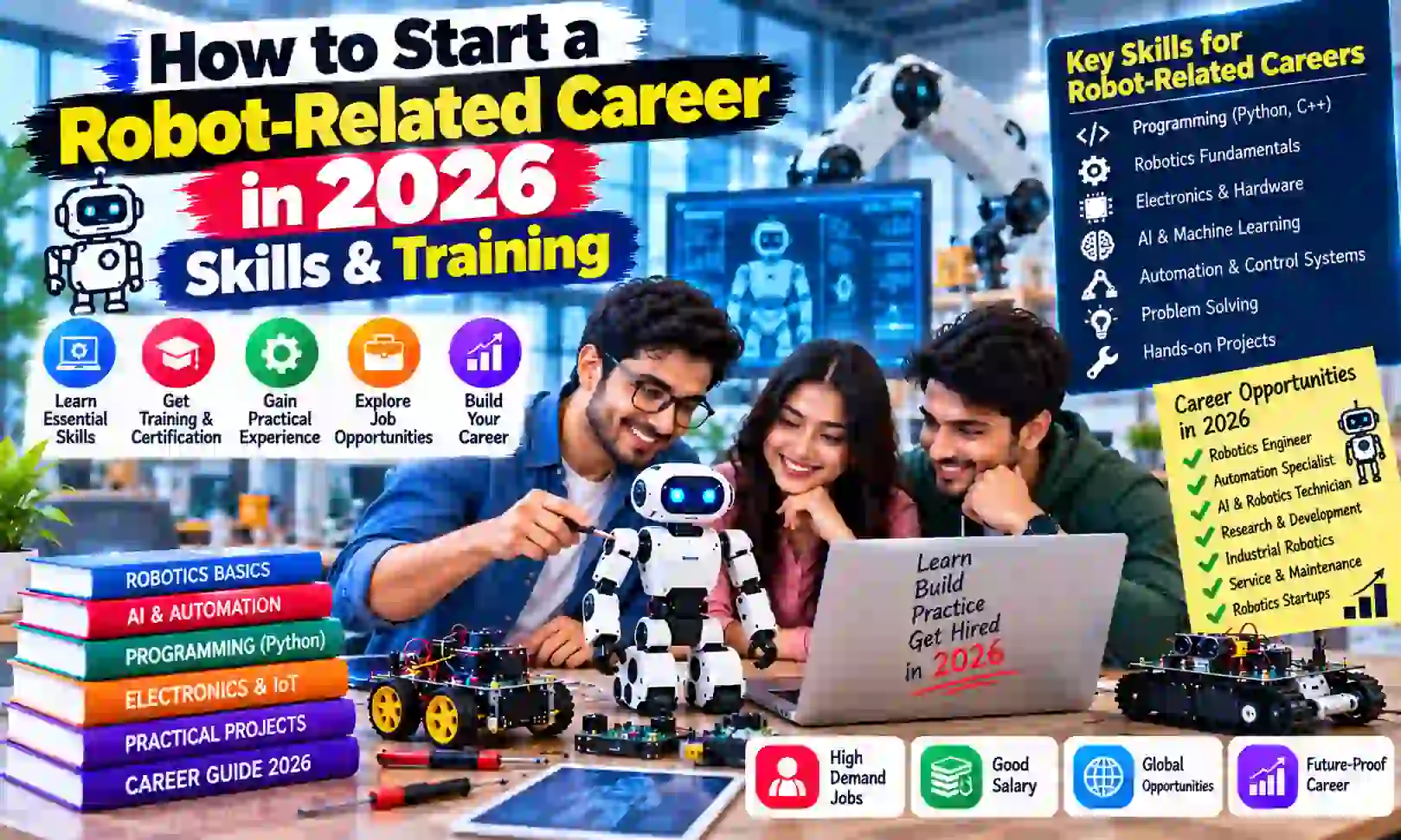
Building a future-proof profile means mastering a specific technical stack. You do not need to be a master of every domain on day one, but your skill set should target these core pillars:
- Core Programming Languages: \mathbf{C++} remains the gold standard for low-latency, real-time control loops and core ROS nodes. \mathbf{Python} dominates high-level AI integration, perception scripting, and rapid prototyping. Additionally, \mathbf{Rust} is rapidly gaining ground for safety-critical embedded systems.
- Middleware & Frameworks: Master ROS 2 (Robot Operating System). It is the universal backbone for managing modular software nodes, topics, and hardware abstraction layers.
- Perception and Navigation: Learn how robots interpret their surroundings using OpenCV for computer vision, along with SLAM (Simultaneous Localization and Mapping) frameworks like Nav2 and LiDAR sensor fusion.
- Simulation Environments: Gain hands-on proficiency in Gazebo, Ignition, or NVIDIA Isaac Sim to test kinematics, sensor noise, and path-planning algorithms safely.
- Embedded Systems & Firmware: Understand how to interface with microcontrollers (STM32, ESP32, Arduino) and work with real-time operating systems (RTOS) like FreeRTOS or Zephyr.
4. High-Demand Career Tracks & Roles
The robotics ecosystem offers several distinct career paths depending on whether your interests lean toward software development, simulation, or physical hardware:
- Robotics Software Engineer: Architects and writes the ROS 2 software stack, integrating sensor drivers with high-level autonomy logic.
- Simulation / Digital Twin Engineer: Develops virtual environments and generates synthetic training data to validate robot behaviors prior to real-world deployment.
- AI / Perception Engineer: Focuses on deep learning, computer vision, and sensor fusion models that allow robots to navigate complex, unstructured environments.
- Controls & Mechatronics Engineer: Designs the physical heartbeat of the system, handling motor controllers, feedback loops, kinematics, and actuator dynamics.
- Robotics System Integrator / Technician: Deploys and maintains automation cells on factory floors or logistics hubs, ensuring mechanical, electrical, and software components work in harmony.
5. Strategic Training Paths: Degrees vs. Practical Portfolios
There are two primary routes to building the competency required for a modern robotics career:
The Traditional Academic Route
Pursuing a degree in Robotics Engineering, Mechatronics, Computer Science, or Electrical Engineering provides rigorous theoretical grounding in linear algebra, control theory, and hardware design. To maximize its value, couple your coursework with hands-on extracurricular projects, student design teams, or open-source software contributions.
The Modern Open-Source & Portfolio Route
Because robotics has an active open-source community, self-directed learners can build world-class portfolios without formal degrees. A practical self-directed learning plan involves:
- Establish Fundamentals: Master Linux (Ubuntu terminal navigation), linear algebra, and basic Python/C++ syntax.
- Learn ROS 2 & Simulation: Build a virtual differential-drive robot in Gazebo or Isaac Sim and write custom ROS 2 nodes to control its movement.
- Build and Document Projects: Create 2 to 3 end-to-end projects—such as a simulated SLAM navigation pipeline or an ESP32-based sensor logger—and publish clean repositories on GitHub.
- Network and Engage: Participate in developer forums, local robotics meetups, and open-source contribution channels to connect with hiring managers.
6. Robotics Career Track Comparison Matrix
Review the comparative matrix below to match your professional background with the right specialization:
| Career Track | Core Focus | Essential Tools & Stack | Average US Salary Range |
|---|---|---|---|
| Robotics Software Engineer | Middleware & Autonomy Logic | ROS 2, C++, Python, Linux | $125,000 – $145,000 |
| AI / Perception Engineer | Computer Vision & Learning | PyTorch, OpenCV, Sensor Fusion | $150,000 – $185,000 |
| Simulation Engineer | Digital Twins & Virtual Testing | NVIDIA Isaac Sim, Gazebo | $135,000 – $155,000 |
| Controls & Mechatronics | Actuators, Feedback, Dynamics | MATLAB/Simulink, RTOS, CAD | $115,000 – $130,000 |
| Robotics System Integrator | Factory Deployment & Tooling | PLCs, Cobots, End-Effectors | $110,000 – $125,000 |
7. Frequently Asked Questions
1. What programming language should I learn first for robotics?
Start with Python for rapid scripting and understanding high-level logic, then transition quickly to C++, which is mandatory for writing low-latency, high-performance production code on actual robots.
2. Can I break into robotics without buying expensive hardware?
Yes. Thanks to advanced simulators like Gazebo and NVIDIA Isaac Sim, you can design, program, and test complex robotic systems entirely on a standard PC before ever touching physical hardware.
3. How important is ROS 2 on a resume?
Extremely important. ROS 2 is the universal industry standard framework. Knowing how to structure nodes, manage topics, and configure transforms is one of the most frequently requested criteria in job postings.
4. Are remote work options common in the robotics industry?
Roles focused on software architecture, simulation, and AI model training offer robust remote flexibility. However, positions involving physical hardware integration, sensor calibration, and field testing require on-site presence.
8. Conclusion and First Steps
Starting a robot-related career requires a blend of foundational technical curiosity and steady mastery over modern tools like ROS 2, simulation engines, and Physical AI frameworks. By committing to hands-on projects and building a verifiable public portfolio, you position yourself at the forefront of the automated economy. What specific area of the robotics stack—simulation, software engineering, or perception—are you going to focus on first?